English version below
Nouvelles toutes fraîches (c’est appréciable) pour cette deuxième newsletter HARMI. Vous retrouverez les évènements et actions en cours, les lauréats de financements variés et les appels à propositions pour soutenir les actions de recherche et de formation en microbiologie en Bourgogne-Franche-Comté. En supplément dans cette édition, les questions-réponses sur l'AAP3 HARMI.
A LA UNE
Troisième tour de Manège
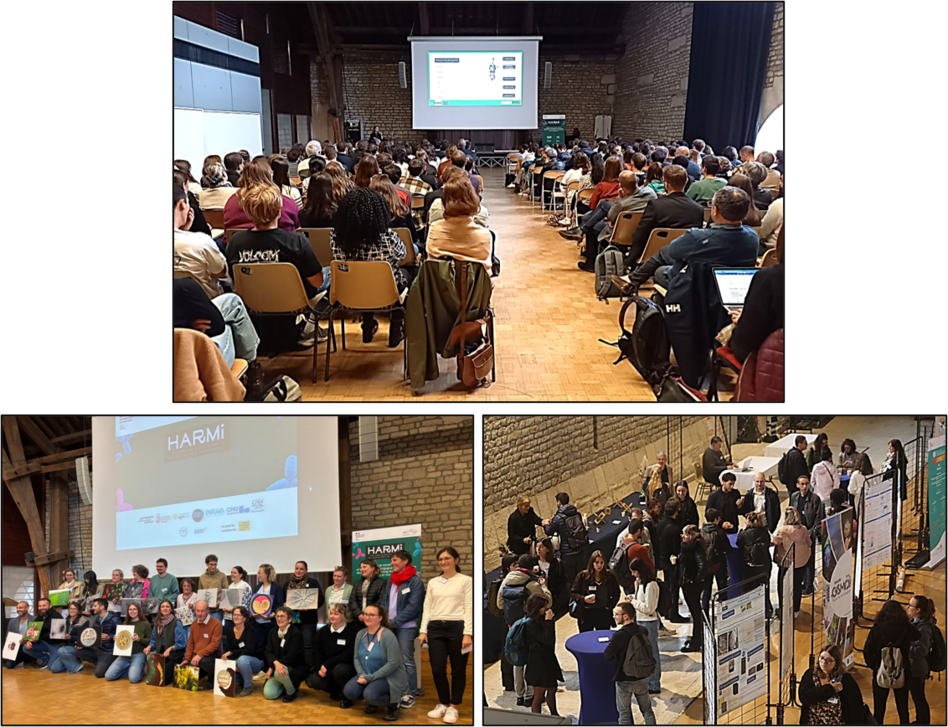
Rendez-vous à Dole au Manège de Brack pour le 3e symposium HARMI les 15 et 16 septembre 2026. L’année dernière, l’évènement avait rassemblé 234 participants, dont 135 chercheurs, 78 étudiants et des représentants de six entreprises.
Les conférences invitées seront données cette année par Marie Simonin (microbiotes des plantes), Karim Benzerara (géomicrobiologie) et Xavier Bellanger (antibiorésistance).
Programme du symposium 2026 bientôt disponible ici
Du champ à l'assiette
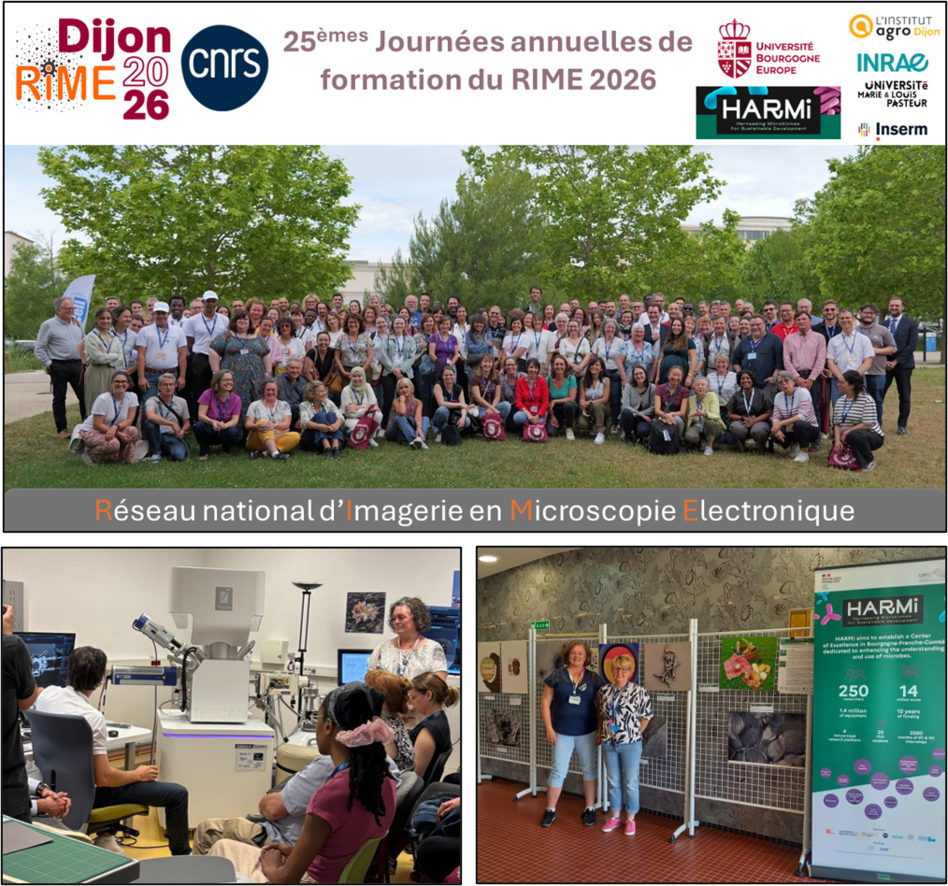
Lauréate d’un co-financement HARMI, la plateforme DImaCell a organisé la summer school Les 25èmes journées du RIME : « Du champ à l’assiette : la microscopie électronique pour imager les artisans de l’invisible, les cellules et les micro-organismes » à Dijon du 1er au 3 juin 2026. L’évènement a réuni 150 participants et 35 partenaires industriels (15 sociétés privées).
Un grand merci à tout le comité d’organisation pour ces trois formidables journées de présentations, de posters et de discussions, entre partenaires académiques et partenaires industriels, montrant le vaste champ d’action de la microscopie pour étudier les micro-organismes.
Pour bénéficier d’un financement HARMI pour l’organisation de séminaires/workshops/summer schools, voir rubrique “Appels à Propositions”
Tarif réservé aux mobiles
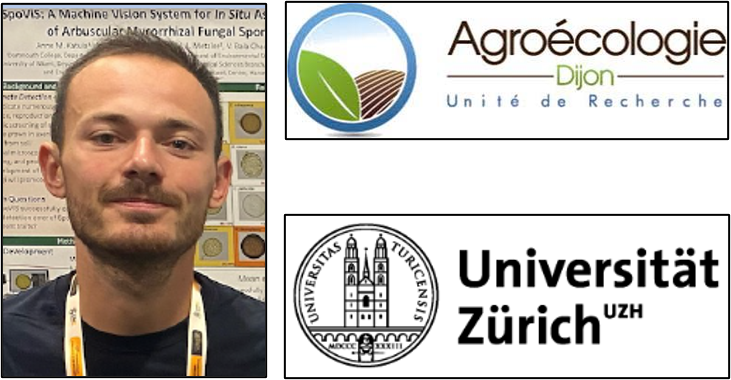
Célien Durney est le 1er postdoctorant à bénéficier d’une bourse de mobilité HARMI de 2000 €. En postdoctorat à l’UMR Agroécologie, il sera accueilli pour environ 3 mois à l’université de Zürich pour travailler sur la caractérisation fonctionnelle des communautés bactériennes associées à différents champignons mycorhiziens à arbuscules, dont Rhizophagus irregularis, et leur impact sur la physiologie des plantes.
Pour bénéficier d’une bourse de mobilité internationale pour doctorants/postdoctorants
voir rubrique “Appels à Propositions”
Microbiologistes en devenir
Le Forum des Jeunes Chercheurs s’est tenu les 4 et 5 juin 2026 à l’UFR des Sciences de Santé à Dijon. Rendez-vous scientifique annuel de l’École Doctorale Environnements-Santé, il permet aux doctorants de présenter leurs travaux, d’échanger autour de leurs thématiques de recherche et de favoriser l’émergence de collaborations interdisciplinaires.
HARMI a soutenu financièrement cette édition qui incluait une session HARMI dans son programme, constituée de conférences données par les doctorants du périmètre du projet. L’évènement a compté 4 présentations orales et 12 posters rentrant dans les thématiques du projet.
Sciences à domicile pour les Masters
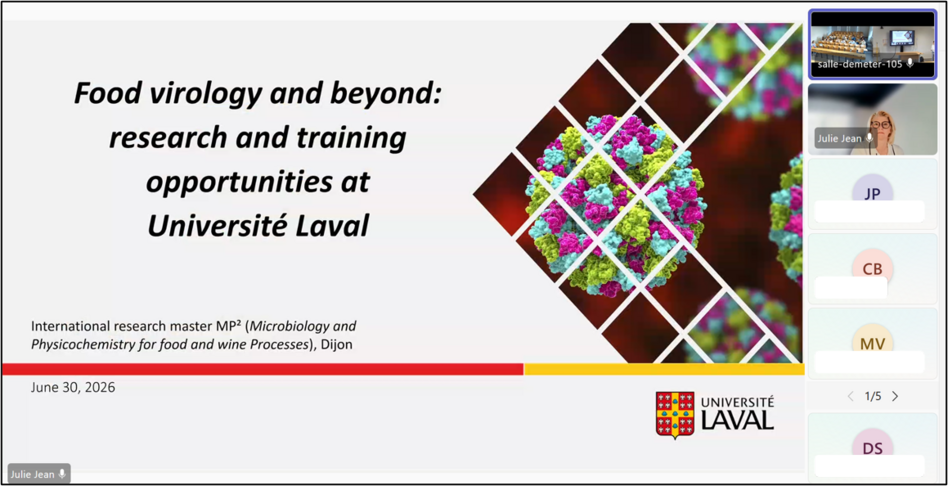
Organisée par leMaster MP2, la conférence de Julie Jean (Université Laval, Québec) a eu lieu en visioconférence le 30 juin 2026.
Elle a présenté ses travaux sur les contaminations virales dans l’alimentation et a parlé des opportunités de formation au sein de son laboratoire. Partagée avec les chercheurs et étudiants du site Bourgogne-Franche-Comté, la conférence a compté une trentaine de participants.
C’est la 3e conférence d’experts internationaux pour Masters partagée avec la communauté HARMI en 2025-2026.
HARMI promeut la mise en réseau de ses 10 Masters partenaires(1) et l’internationalisation de la formation en microbiologie en encourageant l’organisation et la diffusion de cours spécialisés d’experts internationaux
(1) AMAQ, B2IPME, EMME, FORTHEM, GDE, MAGE, MB, MP2 , PFAA, SP2G
Je suis ton harmi
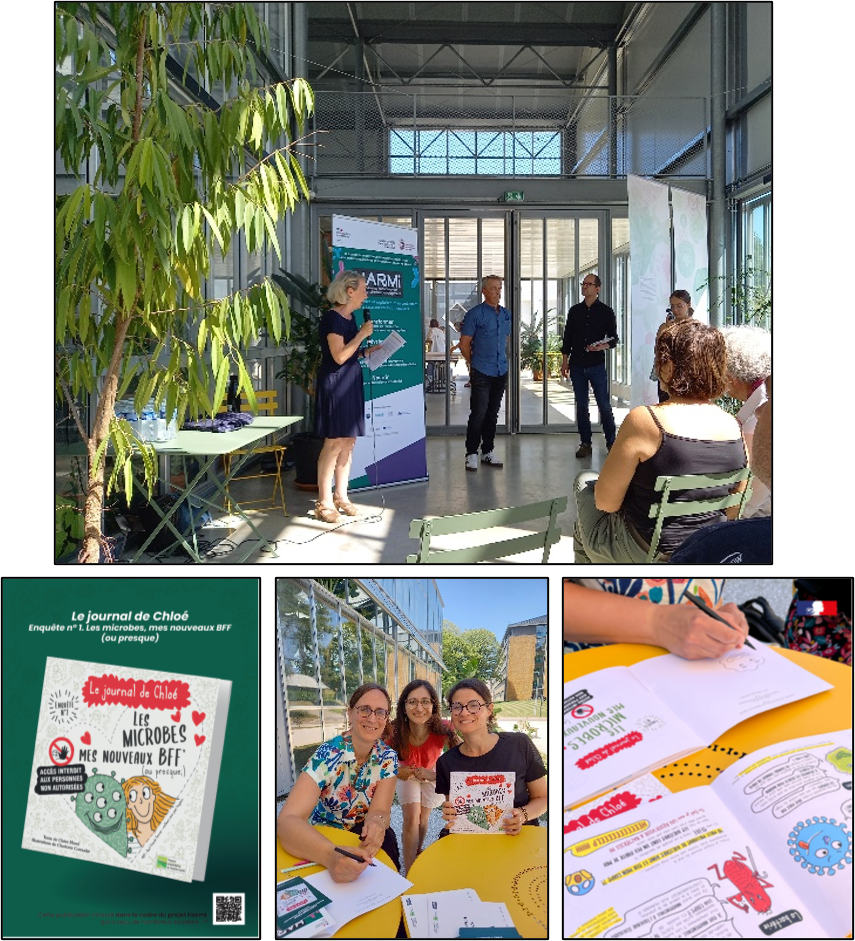
C’est au Biome (Besançon) que s’est tenue l’inauguration du premier livre de vulgarisation grand public HARMI le 18 juin 2026 : « Le journal de Chloé - Tome 1 : Les microbes, mes nouveaux BFF ».
Produit de la collaboration avec Claire Morel (autrice) et Charlotte Cornudet (illustratrice), cet ouvrage fera découvrir au jeune public le monde de la microbiologie à travers les aventures d’une adolescente.
Ce premier tome, généraliste, balaye cinq grands thèmes de nos unités : communautés microbiennes du sol, antibiorésistance, ferments alimentaires, géomicrobiologie et microbes en bioremédiation.
Le 2e tome, sur le thème de la fermentation, est en cours de préparation et sortira en 2027.
Le livre, édité aux Presses Universitaires de Franche-Comté (PUFC), est en vente ici.
Microbes de collections…
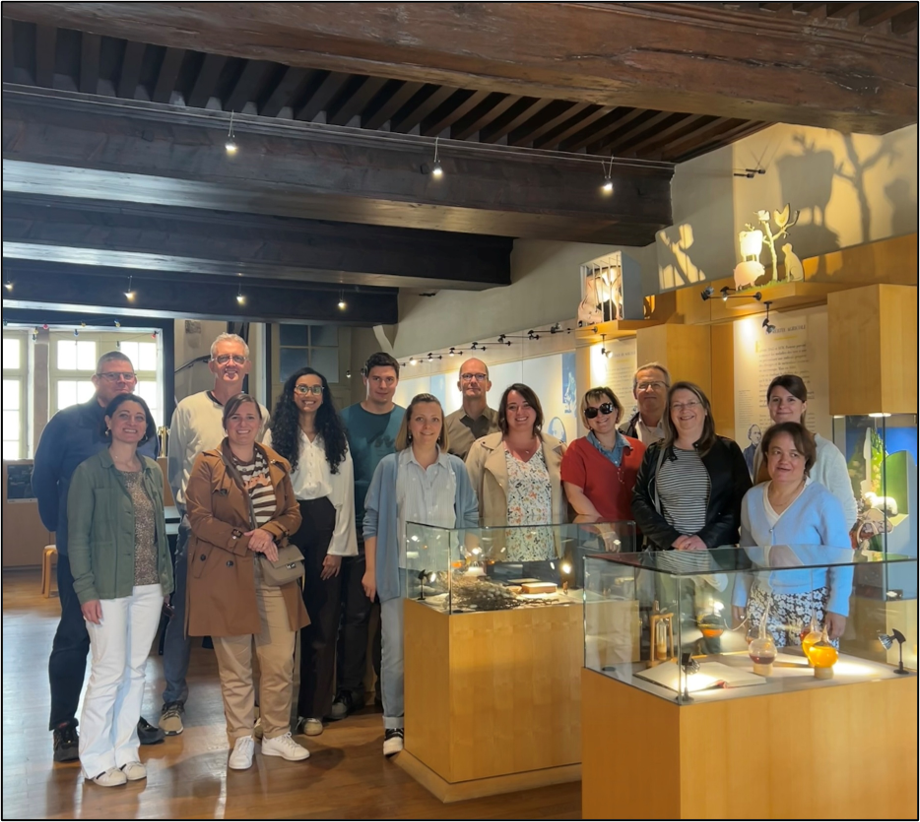
La journée des collections microbiennes partenaires d’HARMI, organisée par l’ingénieure qualité HARMI, Chahrazade Abouelaz, a eu lieu le jeudi 21 mai 2026 à la Maison Pasteur à Dole.
Elle a réuni 13 personnels des différentes collections microbiennes du site Bourgogne-Franche-Comté : CRB-FMB (CHU de Besançon-Franche-Comté), MIAE champignon (UMR Agroécologie), IBG (UMR Agroécologie) , collection Pollution (UMR Chrono-environnement) et collection ferments microbiens (plateforme FROMEX).
Au programme des discussions : modèles de MTA (Material Transfer Agreement), protocole de Nagoya, collections miroirs et financements pour la gestion des données.
… et plateformes de qualité.

La journée des plateformes partenaires d’HARMI, organisée par l’ingénieure qualité HARMI, Maëlle Deshoux, a eu lieu le lundi 29 juin 2026 à Dijon à l’UFR SVTE de l’Université Bourgogne Europe (bâtiment Gabriel).
Elle a réuni une quarantaine de personnels de 8 des 9 plateformes techniques HARMI du site Bourgogne-Franche-Comté : 2B2S, 4PMI, Biotech’Innov, DImaCell, DIVVA, FROMEX, Genosol, GISMO et PEA2t.
Cette première journée a permis à chaque plateforme de présenter ses activités et d’échanger sur les approches qualité (gestion documentaire, périmètres de certification ISO 9001…). La SATT SAYENS est intervenue sur les aspects Qualité.
DERNIÈRES PUBLICATIONS
Tomko P; Ovando-Ovando CI; Boussagol P ; Santiago-Martínez MG; Visscher PT. Methanogens through time and space: impact on Earth’s planetary evolution and biogeochemistry. Geosciences 2026, 16 (14), p.144. https://dx.doi.org/10.3390/geosciences16040144
Boussagol, P.; Vennin, E.; Motreuil, S.; Bonnotte, A.; Jouve, G.; Millet, L.; Munier, T.; Visscher, P. T. Enhanced Carbonate Production Model for Temperate Stratified Lakes. Limnol. Oceanogr. 2026, 71 (2), e70334. https://doi.org/10.1002/lno.70334
Visscher, P. T.; Boussagol, P.; Bourillot, R.; Dupraz, C.; Braissant, O.; Decho, A. W.; Burns, B. P.; White III, R. A.; Tomko, P.; Vennin, E. A Critical Role of Heterotrophic Bacteria in Early Diagenesis of Carbo
APPELS A PROPOSITION
AAP3 HARMI
HARMI peut financer 6 projets starters, 3 projets transversaux, 3 projets internationaux et 3 projets industriels.
Propositions à envoyer jusqu’au 9 octobre 2026 à 13h
Détails et conditions sur la page web HARMI
Supplément : FAQ disponible en fin de newsletter
Appel à propositions : Financements de séminaires/workshops/summer schools en 2026
HARMI peut financer 10 séminaires, 3 workshops et 2 summer schools en BFC jusqu’au 1er décembre 2026.
Propositions à envoyer au minimum 2 mois avant l’évènementet au plus tard le 1er octobre 2026.
Détails et conditions sur la page web HARMI
Appel à candidatures : Bourses pour des séjours scientifiques de doctorants/postdoctorants dans des laboratoires étrangers en 2026-2027
HARMI peut financer jusqu’à 5 bourses par an (2000€ maximum).
Propositions à envoyer avant le 1er octobre 2026pour des séjours entre décembre 2026 et avril 2027.
Détails et conditions sur la page web HARMI
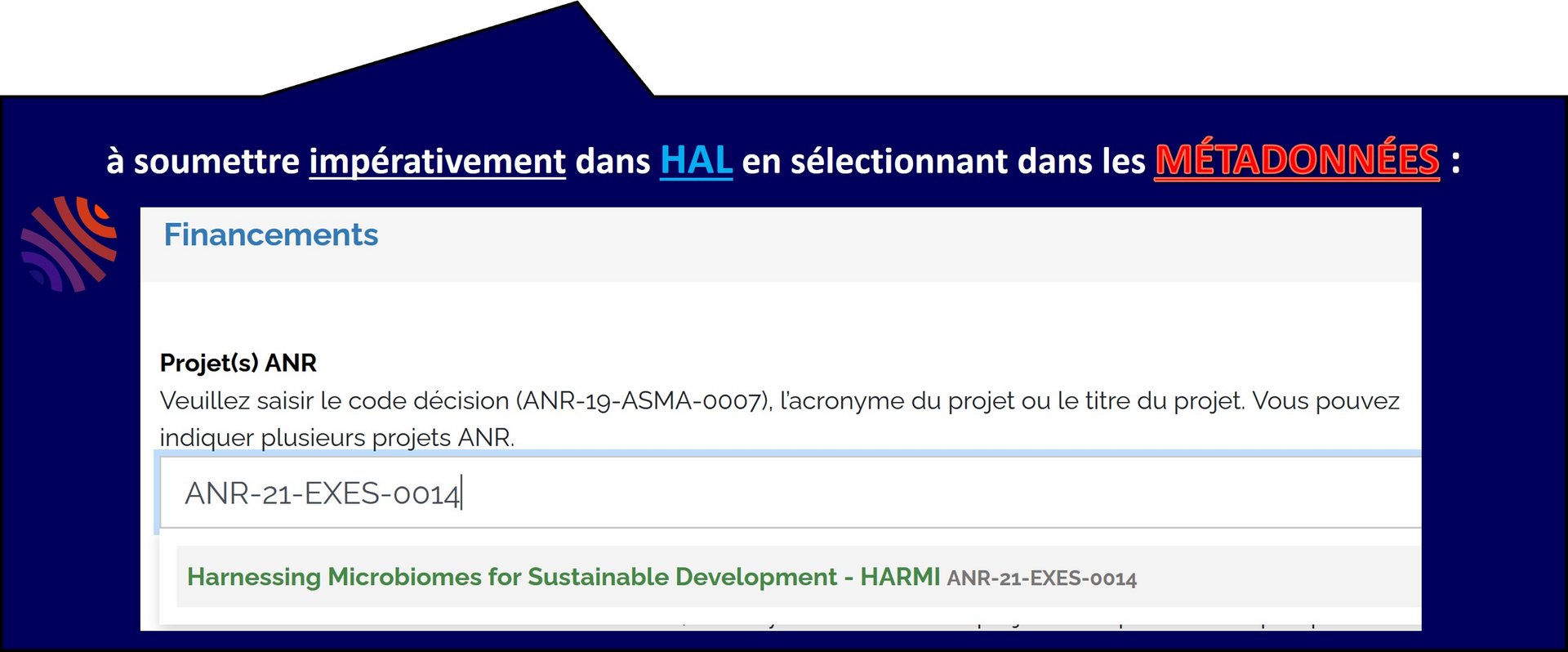
Toute obtention d’un financement HARMI impose un engagement strict à mentionner dans les publications et les communications scientifiques le soutien et la référence du projet selon l’exemple :
“This research was funded by the HARMI (HARnessing MIcrobiomes for sustainable development) project (ANR-21-EXES-0014) under the France 2030 program managed by the ANR and funded by The European Union NextGenerationEU."
AGENDA HARMI
SEPTEMBRE | |
Evènements | |
15-16/09 | 3e Symposium HARMI Lieu: Manège de Brack, Dole |
Deadlines | |
30/09 | Candidatures pour des bourses pour des séjours scientifiques de doctorants/postdoctorants dans des laboratoires étrangers entre décembre 2026 et avril 2027 |
| Propositions pour le financement de séminaires/workshops/summer schools en 2026 |
OCTOBRE | |
Deadlines | |
09/10 | Propositions pour le financement de projets dans le cadre de l’AAP3 |
NOUS CONTACTER
Pour toute question, contacter harmi(at)umlp.fr
Page web HARMI https://www.umlp.fr/harmi
Retrouvez-nous sur LinkedIn HARMI-Microbiomes

Le projet HARMI est financé par le programme d’Etat France 2030 géré par l’ANR (référence ANR-21-EXES-0014) et financé par l’Union Européenne (NextGenerationEU).
FAQ AAP3 HARMI
CRITÈRES
Les critères d’éligibilité (interdisciplinarité, caractère structurant, minimum 2 unités de recherche de Bourgogne-Franche-Comté) s’appliquent-ils à tous les types de projets ?
OUI ! Tous les projets : starters, transversaux, internationaux et industriels.
SIGNATURES DES DIRECTIONS DE LABOS
Qui doit signer la proposition de projet ? Les directeurs d'unité de toutes les unités impliquées ou seulement le DU de l’unité du porteur ?
Tous les DU des unités de Bourgogne Franche-Comté impliquées doivent signer la proposition.
Les prestataires/les plateformes doivent-ils signer ?
Non, ce n'est pas obligatoire.
Les laboratoires étrangers doivent ils signer le projet (en plus de leur lettre d’engagement) ?
Le directeur de laboratoire de l'équipe internationale peut faire partie des signataires, sans que ce soit une obligation. La lettre de collaboration du partenaire international est bien obligatoire.
Un postdoc peut-il être porteur d’un projet ?
Non, les porteurs doivent être titulaires.
FINANCEMENTS
Les frais de publication sont-ils éligibles ?
Oui, à indiquer dans Consumables & operating costs.
PROJETS INDUSTRIELS
Qu’est-ce qu’un partenaire industriel ?
Un partenaire industriel peut être une entreprise privée ou un autre acteur d’un secteur économique (par exemple une chambre d’agriculture).
Pour les projets industriels, doit-on forcément recruter un doctorant ou un postdoctorant ?
Non, les projets industriels sont désormais plus souples et il n’y a pas d’obligation de recrutement. Il n’y a plus de durée minimale, ce peuvent être de petits projets de courte durée.
Pour les projets industriels, le coût du matériel dont a besoin le partenaire industriel pour son workpackage peut-il être inclus dans les 150 k€ ?
Oui, c'est possible tant que le partenaire apporte bien par ailleurs un cofinancement égal au budget HARMI demandé (dont 30% minimum en numéraire), et que les règles de l'appel sont respectées.
Pour toute autre question, contacter harmi(a)umlp.fr !
Version française au-dessus
Fresh news (it's appreciable) for this second HARMI newsletter. You will find current events and actions, the winners of various funding and calls for proposals to support research and training actions in microbiology in Bourgogne-Franche-Comté. As a supplement to this edition, the questions and answers on the HARMI 3rd call for proposals (AAP3).
HEADLINES
Back in the arena: round 3
See you in Dole at Manège de Brack for the 3rd HARMI symposium on September 15 and 16, 2026. Last year, the event brought together 234 participants, including 135 researchers, 78 students and representatives from six companies.
The invited lectures will be given this year by Marie Simonin (plant microbiota), Karim Benzerara (geomicrobiology) and Xavier Bellanger (antibiotic resistance).
HARMI 2026 symposium program coming soon here
From field to fork
Winner of a HARMI co-funding, the DImaCell platform organized the summer school The25th RIME Days: "From the field to the plate: electron microscopy to image the artisans of the invisible, cells and microorganisms" in Dijon from June 1 to 3, 2026.
The event brought together 150 participants and 35 industrial partners (15 private companies)
A big thank you to the entire organizing committee for these three outstanding days of presentations, poster sessions and discussions, between academic and industrial partners, highlighting the broad range of applications of microscopy in the study of microorganisms.
To benefit from HARMI funding for the organisation of seminars/workshops/summer schools, see section “Calls for Proposals”
Mobile rates only
Célien Durney is the 1stpostdoctoral fellow to benefit from a HARMI mobility grant of 2000 €. Currently a postdoc in the Agroecology unit, he will be hosted at the University of Zurich for about 3 months to work on the functional characterization of bacterial communities associated with different arbuscular mycorrhizal fungi, including Rhizophagus irregularis, and their impact on plant physiology.
To benefit from an internationalmobility grant, for doctoral students/postdoctoral fellows, see section "Calls for Proposals"
Microbiologists in the making
The Young Researchers' Forum was held on June 4 and 5, 2026 at the Faculty of Health Sciences in Dijon. This annual scientific meeting organized by the Environment-Health Doctoral School allows doctoral students to present their work, discuss their research themes and promote the emergence of interdisciplinary collaborations.
HARMI financially supported this edition, which included a dedicated HARMI session featuring talks by PhD students within the project's scope.
The event featured 4 oral presentations and 12 poster presentations within the scope of the project's research themes.
Guest lecture for Master’s students
organized by the MP2 Master's program, Julie Jean’s conference (Université Laval, Québec), was held online on June 30, 2026.
She presented her research on viral contamination in food and discussed training opportunities available within her laboratory. Shared with researchers and students across the Bourgogne-Franche-Comté site, the seminar was attended by around thirty participants.
It is the third conference of international experts for Masters, shared with the HARMI community in 2025–2026.
HARMI promotes networking among its 10 partner Master’s programs(1)and the internationalization of microbiology education by encouraging the organization and dissemination of specialized courses delivered by international experts
(1) AMAQ, B2IPME, EMME, FORTHEM, GDE, MAGE, MB, MP2 , PFAA, SP2G
You’ve got a friend in harmi
The inauguration of the first HARMI vulgarizing book for the general public, "Chloé's diary (Volume 1: Microbes, my new BFFs)“, was held on June 18, 2026 at the Biome (Besançon).
As a result of the collaboration with Claire Morel (author) and Charlotte Cornudet (illustrator), the book will introduce young audiences to the world of microbiology through the adventures of a teenage girl.
This first generalist volume covers five major themes from our units: soil microbial communities, antibiotic resistance, food ferments, geomicrobiology and microbes in bioremediation.
The second volume, dedicated to fermentation, is currently being prepared and is scheduled for publication in 2027.
The book, published by the Presses Universitaires de Franche-Comté (PUFC) is on sale here.
Microbial collections…
The HARMI partner microbial collections day, organized by the HARMI quality engineer, Chahrazade Abouelaz, took place on May 21, 2026 at Maison Pasteur in Dole.
It brought together 13 staff from the various microbial collections from the Bourgogne-Franche-Comté site:CRB-FMB (Besançon-Franche-Comté University Hospital), MIAE champignon(Agroecology unit), IBG (Agroecology unit) , Pollution collection (Chrono-environment unit) and microbial ferments collection(FROMEX platform).
On the agenda for discussion: MTA (Material Transfer Agreement) models, Nagoya Protocol, mirror collections and funding for data management.
… and quality platforms.
The HARMI partner platforms day, organized by the HARMI quality engineer, Maëlle Deshoux, took place on June 29, 2026 in Dijon at SVTE Faculty in Université Bourgogne Europe (Gabriel building).
It brought together around forty staff members from 8 of the 9 HARMI technical platforms from the Bourgogne–Franche-Comté site: 2B2S, 4PMI, Biotech’Innov, DImaCell, DIVVA, FROMEX, Genosol, GISMO et PEA2t.
This first meeting provided an opportunity for each platform to present its activities and discuss quality management practices (document management, ISO 9001 certification scope, etc.). The SATT SAYENS presented on Quality-related aspects.
LATEST PUBLICATIONS
Tomko P; Ovando-Ovando CI; Boussagol P ; Santiago-Martínez MG; Visscher PT. Methanogens through time and space: impact on Earth’s planetary evolution and biogeochemistry. Geosciences 2026, 16 (14), p.144. https://dx.doi.org/10.3390/geosciences16040144
Boussagol, P.; Vennin, E.; Motreuil, S.; Bonnotte, A.; Jouve, G.; Millet, L.; Munier, T.; Visscher, P. T. Enhanced Carbonate Production Model for Temperate Stratified Lakes. Limnol. Oceanogr. 2026, 71 (2), e70334. https://doi.org/10.1002/lno.70334
Visscher, P. T.; Boussagol, P.; Bourillot, R.; Dupraz, C.; Braissant, O.; Decho, A. W.; Burns, B. P.; White III, R. A.; Tomko, P.; Vennin, E. A Critical Role of Heterotrophic Bacteria in Early Diagenesis of Carbo
CALLS FOR PROPOSALS
Call for research proposals: AAP3 HARMI
HARMI can fund 6 starter projects, 3 transversal projects, 3 international projects et 3 industrial projects.
Proposals must be submitted by 1:00 p.m. on October 9, 2026
Details and conditions on HARMI webpage
Supplément : FAQ available at the end of the newsletter.
Call for proposals: Funding for seminars/workshops/summer schools in 2026
HARMI can fund 10 seminars, 3 workshops, and 2 summer schools in Bourgogne-Franche-Comté region until December 1, 2026. Proposals must be submitted at least 2 months before the eventand at the latest by October 1, 2026.
Details and conditions on HARMI webpage
Call for Applications: Grants for research stays by PhD students and postdoctoral fellows in foreign laboratories in 2026–2027
HARMI can fund up to five grants per year (maximum €2,000).
Applications must be submitted by October 1, 2026, for stays between December 2026 and April 2027.
Details and conditions on HARMI webpage
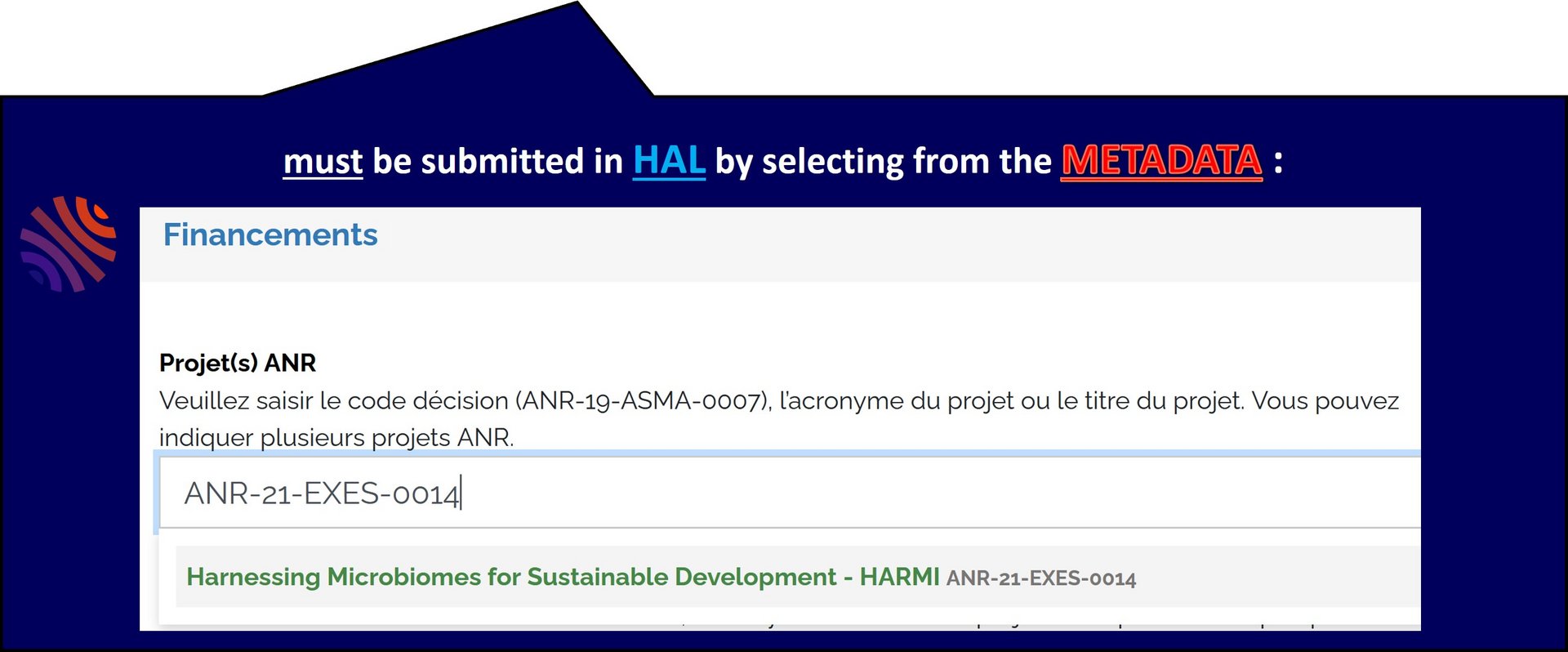
Any HARMI funding received carries a strict obligation to cite the project support and reference in all resulting scientific publications and communications according to the example:
“This research was funded by the HARMI (HARnessing MIcrobiomes for sustainable development) project (ANR-21-EXES-0014) under the France 2030 program managed by the ANR and funded by The European Union NextGenerationEU."
HARMI SCHEDULE
SEPTEMBER | |
Events | |
15-16/09 | HARMI 3rd Symposium Location: Manège de Brack, Dole |
Deadlines | |
30/09 | Applications submission for grants for research stays for PhD students/postdoctoral fellows in foreign laboratories between December 2026 and April 2027 |
| Proposals submission for funding seminars, workshops, and summer schools in 2026 |
OCTOBER | |
Deadlines | |
09/10 | Proposals submission for project funding under the 3rd call for research proposals (AAP3) |
CONTACTER US
For any question, contact harmi(at)umlp.fr
HARMI webpage https://www.umlp.fr/harmi
Find us on LinkedIn HARMI-Microbiomes
Le projet HARMI est financé par le programme d’Etat France 2030 géré par l’ANR (référence ANR-21-EXES-0014) et financé par l’Union Européenne (NextGenerationEU).
FAQ AAP3 HARMI
CRITERIA
Do the eligibility criteria (interdisciplinarity, structuring character, minimum 2 units from Bourgogne-Franche-Comté) apply to all types of projects?
YES! All projects: starter, transversal, international and industrial.
SIGNATURES FROM THE LAB DIRECTORS
Who should sign the project proposal? The unit directors of all the units involved or only the UD of the PI’s unit?
All DUs from the Bourgogne-Franche-Comté units involved must sign the proposal.
Do service providers/platforms have to sign?
No, it is not mandatory.
Do foreign laboratories have to sign the project (in addition to their letter of commitment)?
The laboratory director of the international team may be one of the signatories, but this is not an obligation. The letter of collaboration from the international partner is mandatory.
Can a postdoc be the leader of a project?
No, the PI must be a permanent researcher.
FUNDING
Are publication fees eligible?
Yes, to be indicated in Consumables & operating costs.
INDUSTRIAL PROJECTS
What is an industrial partner?
An industrial partner can be a private company or another player in an economic sector (e.g. a chamber of agriculture).
For industrial projects, do we necessarily need to recruit a PhD student or a postdoctoral fellow?
No, industrial projects are now more flexible and there is no obligation to recruit. There is no longer a minimum duration, they can be small projects of short duration.
For industrial projects, can the cost of the material that the industrial partner needs for its workpackage be included in the €150k?
Yes, it is possible as long as the partner does provide co-financing equal to the requested HARMI budget (including a minimum of 30% in cash), and that the rules of the call are respected.
For any other question, please contact harmi(a)umlp.fr !